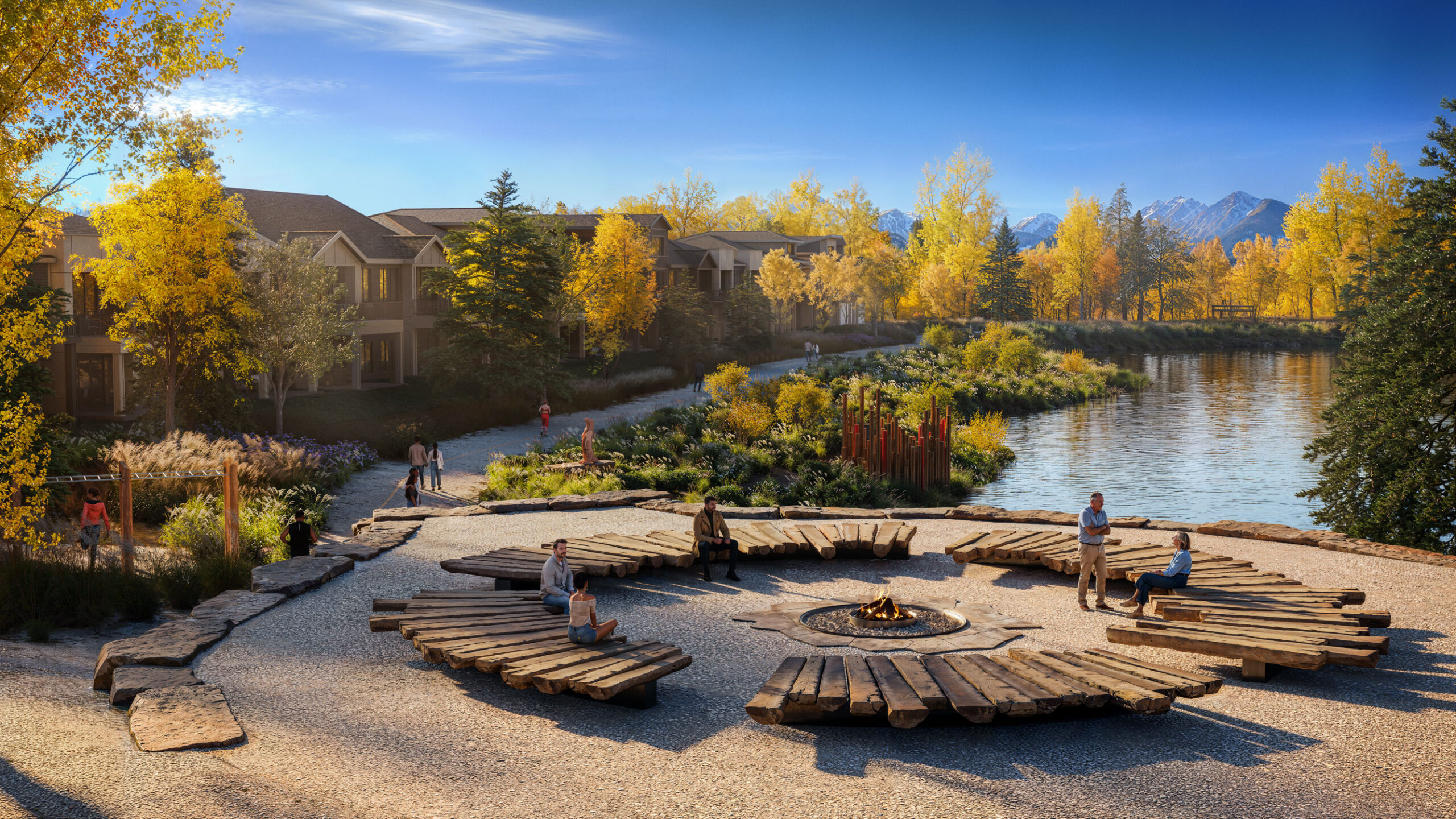

On the southwest edge of Calgary, on the traditional lands of the Tsuut’ina Nation, a new model of large-scale development is taking shape. Taza is a 1,200-acre, Nation-owned economic development vision delivered through a true 50/50 partnership between the Tsuut’ina Nation and Canderel. Together, the partners are building three distinct community villages: Buffalo Run, now an established commercial hub; Taza Park, a 470-acre mixed-use community currently advancing; and The Crossing, a future village planned for a later phase of growth.
More than a master-planned initiative, Taza represents a structural shift in how land development is conceived and executed. Indigenous leadership is foundational, shaping governance, direction, and long-term priorities. Canderel’s role in land development, asset management, and delivery provides the operational expertise required to translate that vision into performance at scale.
What is emerging across Taza is not simply a collection of buildings and infrastructure, but a working example of how partnership-driven development can generate economic opportunity while reinforcing cultural identity, land stewardship, and intergenerational responsibility.
Culture as Framework and Form
At Taza Park, culture functions not as an aesthetic overlay, but as both a governing framework and a lived outcome. Tsuut’ina values reciprocity, stewardship, shared prosperity, and the preservation of language. These values shape how priorities are set, how trade-offs are evaluated, and how commitments are upheld long before they are expressed in built form.
As Maureen Henderson, Vice President of Community Experience explains, these values “don’t sit on the sidelines; they anchor everything,” reinforcing that development is not merely a transaction, but a relationship rooted in responsibility and continuity.
For Randy Dodginghorse, Director of Tsuut’ina Relations, that relationship carries weight. He notes that “our values are tied back to the land, and with that comes an obligation; to communicate properly, to respect protocol, and to make sure people understand what’s happening on their land.” Cultural awareness, in this context, is not symbolic; it informs behaviour. It shapes how teams engage with leadership, how discussions unfold, and how decisions are documented and carried forward. Culture becomes disciplined.
The durability of that discipline is ultimately tested through execution. As planning advances into infrastructure, architecture, and public-realm delivery, intent must withstand the pressures of coordination, cost, and complexity. Vice President of Land Development Travis Oberg acknowledges that “execution is where intent either holds or falls apart,” underscoring that delivery is not separate from vision, but accountable to it.
Since the development is intrinsically tied to the Tsuut’ina Nation, identity cannot be interchangeable. As Oberg explains, “no one else can represent what Tsuut’ina has here,” and that distinctiveness establishes a community character that is both place-specific and enduring.
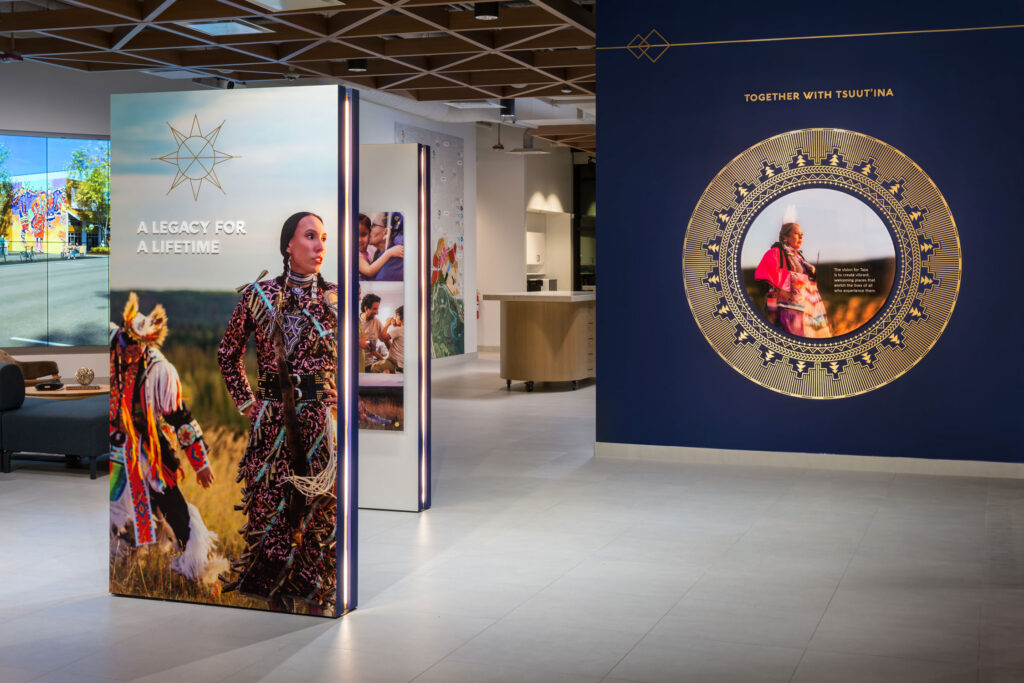
This identity is expressed through street names, signage, public art, landscape design, and architecture. Cultural guidance has shaped everything from beadwork-inspired patterns in streetscape elements to the use of Tsuut’ina language in naming conventions. As Oberg explains, the goal is not to apply cultural references superficially, but to ensure they are grounded in meaning. “When we reference animals, plants, or natural elements that are central to Tsuut’ina teachings, it’s intentional,” he notes. “Whether it’s ensuring chokecherry trees are a focal point along Chokecherry Street, sweetgrass integrated into park spaces, or public art reflecting stories tied to land, water, wind, and fire, those elements are selected with purpose.” Buildings and streets names therefore reference animals, plants, and natural elements central to Tsuut’ina teachings not as decorative gestures, but as expressions of place that connect the built environment back to the land itself.
Delivering this level of coherence requires disciplined coordination across planners, engineers, architects, landscape designers, and builders. Oberg notes that collaboration with the Cultural Committee ensures that cultural elements remain “meaningful and accurate not symbolic gestures.” The emphasis is precision, not performance.
For Henderson, the outcome of this layered approach is experiential integrity. While visitors may not see the governance structures or internal systems behind the work, she observes that “they will feel whether the place is thoughtful and intentional.” At Taza Park, culture moves deliberately from principle to process, shaping both how decisions are made and how the community ultimately takes form.
Building with culture at the centre means that it shows up in both tangible and intangible ways. Visually, this includes the integration of Tsuut’ina design elements into branding, signage, colour palettes, and public art. Experientially, it means creating opportunities for Tsuut’ina artists, musicians, Elders, and storytellers to shape programming and public spaces. Culturally, it also influences how milestones are marked through ceremony, protocol, and respect for tradition.
However, culture also guides less visible decisions. “It influences how we hire, how we communicate, and how we show up,” Henderson explains. “We’ve built Nation-specific roles, collaborative pilot projects, and engagement processes that foreground Tsuut’ina voices. Culture isn’t a theme; it is a daily guidepost.”
Governance Built on Trust and Consensus
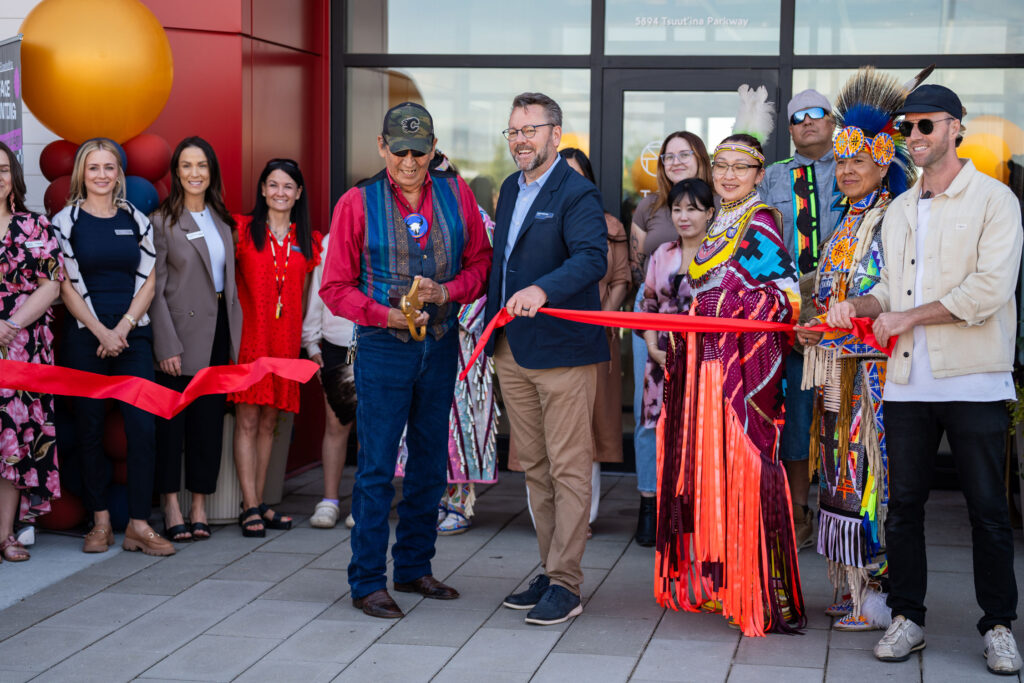
One of the most defining characteristics of the partnership is its governance structure. The Taza board is structured as a true 50/50 partnership, with equal representation from the Tsuut’ina Nation and Canderel. Rather than relying on majority rule, decisions are made through consensus; an approach that reflects both cultural values and a long-term commitment to shared accountability.
For Dodginghorse, this structure is both rare and intentional. “Normally, partnerships aren’t true 50/50,” he explains. “Leadership was very clear, if this was going to be successful, this is the way the governance model had to be built.”
Serving as a bridge between Nation leadership and the development team, Dodginghorse focuses on communication and alignment across worldviews. “At times I say my role at Taza and within the wider Partnership is similar to that of a marriage counsellor,” he says. “Partnerships, like marriages, don’t succeed without ongoing communication.”
From the delivery side, this governance model creates clarity rather than constraint. “It starts at the board level and carries through everything we do,” Oberg explains. “Because decisions are consensus-based, we’re always moving in the same direction. If something isn’t working, we talk about it and adjust together.”
This structure ensures that Tsuut’ina perspectives meaningfully shape outcomes at every level. From strategic direction to day-to-day decision-making rather than being limited to advisory input.
Consultation that Changes Outcomes
Engagement at Taza Park is treated as an ongoing relationship rather than a procedural requirement. Input is gathered continuously from Elders, Knowledge Keepers, youth advisors, artists, educators, entrepreneurs, Nation departments, and leadership through both formal processes and informal conversations rooted in trust.
Dodginghorse emphasizes that trust is built through presence and follow-through. “A lot of people talk about transparency and engagement,” he says. “But what matters is keeping your word doing what you say you’re going to do.”
The impact of this approach is evident in how feedback has directly reshaped development plans. Concerns raised around the Village of Buffalo Run particularly related to residential adjacency, historical sites, and cultural sensitivity prompted a comprehensive review of the Village Development Plan. As a result, public residential uses were removed near Nation homes, and a 40-acre parcel was designated specifically for Nation housing.
For Henderson, the outcome reinforced the importance of listening. “This wasn’t a minor adjustment,” she reflects. “It was a meaningful shift that strengthened the plan and deepened trust. It reaffirmed that when the community speaks, we listen and we help solve problems.”
From an implementation standpoint, Oberg sees responsiveness as critical to long-term success, noting that “when people see that feedback changes outcomes, they invest in the place. That’s when a community starts to take ownership.” For Dodginghorse, that ownership is strengthened not only through visible change, but through ongoing learning. He emphasizes that partnership requires more than consultation — it demands continued effort to understand one another’s perspectives. Ongoing cultural training for development partners, including Canderel’s team, has become an important part of that commitment. As he explains, sustained engagement allows teams to deepen their understanding of Tsuut’ina history, protocol, and values, ensuring that collaboration improves over time rather than remaining static. Continuous learning, in his view, is what enables the partnership to evolve with clarity and respect.
Milestones and Momentum
As construction advances and phases come online, the project moves from coordinated planning into lived reality. Milestones begin to represent more than progress; they signal permanence.
The introduction of residential development marked a defining transition. With the arrival of full-time residents, the community shifted from development initiative to inhabited places. As Oberg explains that moment carried weight because “when people choose to live somewhere, they’re invested. They care deeply about how it evolves.” Residential occupancy changes the cadence of delivery and infrastructure must function seamlessly, amenities must operate immediately, and public spaces must support daily life rather than periodic activation.
That momentum is already visible at the Village of Buffalo Run. Costco serves as a primary anchor, joined by other national brands including Real Canadian Superstore, Tim Hortons, Gold’s Gym, and multiple financial institutions, establishing the district as a significant regional retail and service hub. These tenants generate sustained economic activity for the Tsuut’ina Nation while reinforcing Buffalo Run’s role as a destination that extends beyond the immediate community. Complementary retail and service offerings continue to expand the area’s draw, supported by completed road networks, servicing infrastructure, and landscaped corridors designed to accommodate both current activation and future phases of growth.
In parallel, the first residential phases within Taza Park have been delivered, introducing full-time residents and reinforcing the shift from project to place. Each completed phase demonstrates that the framework established through partnership and governance can be performed under real-world conditions.
Strategic Revitalization Plan
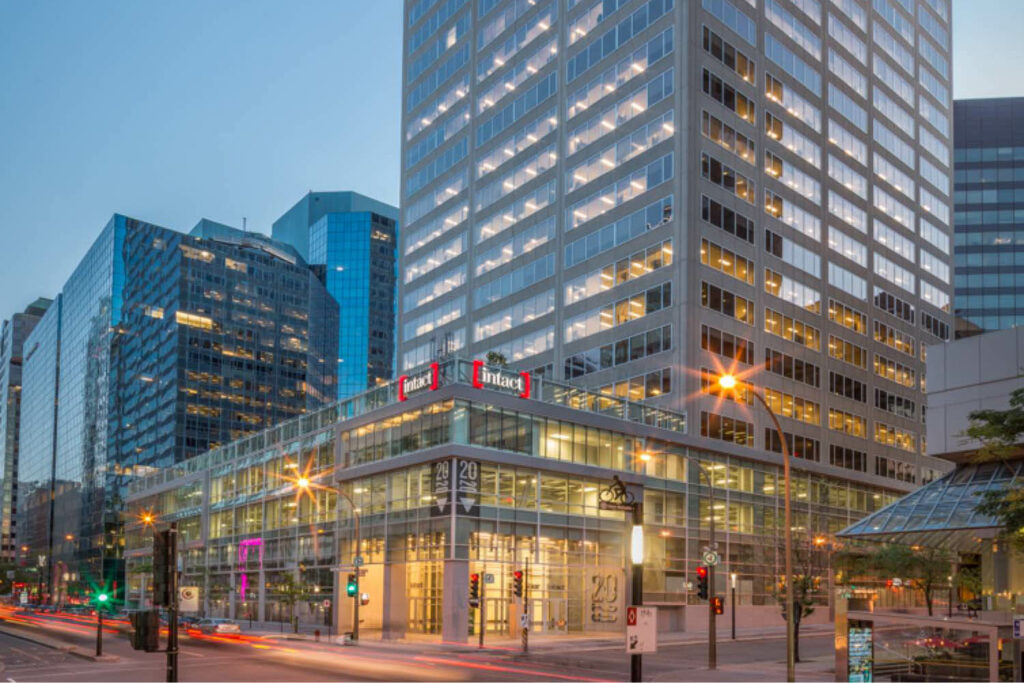
To reposition City Centre Towers as a competitive office destination, a strategic revitalization plan focusing on amenity upgrades, tenant experience enhancements, and environmental improvements was implemented, centered on three key initiatives:

New Amenity Floor: Designed to provide an improved tenant experience with areas for collaboration, socialization, and wellness.
Hospitality-Driven Services: Concierge support and curated tenant events to foster community and engagement.
Operational Maturity at Scale
As the community grows, so does the complexity of delivery. Multiple builders, consultants, infrastructure teams, and stakeholders operate simultaneously across defined phases. Maintaining coherence under these conditions requires discipline.
For Oberg, scale doesn’t change the vision but instead it tests the discipline behind it. “Vision sets the direction, but structure delivers the outcome,” he explains, noting that as projects grow, success depends on translating plans into coordinated action and maintaining alignment from strategy through execution.
Operational maturity also reveals how challenges are addressed. When sequencing adjustments, market shifts, or technical constraints arise, the response is structured rather than reactive. Dodginghorse emphasizes that difficult conversations are inevitable in long-term partnerships, but what matters is returning to shared responsibility and working through complexity deliberately.
Henderson adds that operational discipline ultimately protects the broader vision. Systems and processes must withstand scale, she explains, because “people may not see the mechanics behind it, but they will feel whether it’s coherent.” Consistency across phases preserves experiential integrity.
In the near term, additional residential buildings are scheduled to come online within Taza Park, expanding housing options and increasing on-site population. Further commercial parcels at Buffalo Run are expected to advance through development, reinforcing the district’s position as a regional retail and service hub. Infrastructure expansions including continued road extensions, utility servicing, and public-realm enhancements will support these upcoming phases.
Sustainability as Long-Term Performance
As development advances, sustainability is evaluated through durability rather than declaration. Environmental standards, infrastructure resilience, and economic viability are considered together to ensure long-term stability.
Residential builders are required to meet Built Green Gold certification standards, establishing measurable environmental benchmarks while allowing flexibility in implementation. Renewable energy initiatives, including solar installations, are incorporated where lifecycle value supports long-term benefits.
Oberg says that performance must be evaluated holistically. Environmental impact, economic feasibility, and maintainability over time are inseparable considerations. Sustainability is not positioned as a separate initiative, but as a lens applied to infrastructure planning, servicing capacity, and lifecycle decision-making.
The emphasis is not on short-term optimization, but on durability, structures and strategies capable of sustaining both growth and identity over decades.
Measuring Success Beyond Buildings
As occupancy increases, the metrics of success evolve. Progress is no longer measured solely in approvals or square footage, but in lived experience and sustained participation.
Oberg notes that community experience ultimately becomes one of the most meaningful indicators of performance. What people say when they leave and what they tell others reflects whether the environment resonates beyond its physical form.
The arrival of residents signals a shift from planning to permanence. Patterns of movement, retail support, and daily use provide tangible evidence that the community is functioning as intended. Adoption becomes validation.
At this stage, the project’s success is no longer theoretical. It is reflected in occupancy, engagement, and the steady normalization of the place as part of Calgary’s broader urban fabric.
A Model for the Future
Beyond its physical footprint, Taza Park represents a working model of partnership-driven development one that demonstrates how Indigenous leadership and private-sector expertise can operate in deliberate alignment.
In Dodginghorse’s perspective, the significance of the project extends well beyond the site itself. He describes the work as planting seeds incremental steps that, over time, accumulate into meaningful and lasting change. Reflecting on the Tsuut’ina teaching of walking in two worlds, he speaks to the importance of engaging within mainstream development systems while remaining grounded in Indigenous worldview. These steps, he suggests, are “small, monumental” in their long-term impact.
The partnership between the Tsuut’ina Nation and Canderel has provided both structure and execution, combining cultural leadership with institutional development expertise. Shared governance established clarity; disciplined delivery has ensured performance.
Henderson thinks that the long-term measure of success lies in durability. Decades from now on, she believes the community will stand as evidence of what is possible when structure, stewardship, and execution move forward together. What is emerging is not simply a mixed-use development, but a precedent; one that illustrates how partnership, when grounded in clarity and accountability, can produce places of lasting meaning.
Taza Park does not redefine suburban growth through symbolism alone. It does so through sustained collaboration between the Tsuut’ina Nation and Canderel, a partnership that balances cultural leadership with delivery expertise, and vision with operational rigor.
In doing so, it establishes a benchmark for Indigenous-led development at scale one defined not by aspiration, but by performance.